Overview
Gas giants are massive planets primarily composed of hydrogen and helium, distinguishing them from rocky terrestrial worlds. They play a crucial role in shaping planetary systems by influencing orbital dynamics and protecting inner rocky planets from asteroid impacts.
Definition and Core Characteristics
A gas giant is defined by its overwhelming dominance of light gases—hydrogen and helium, making up over 90% of its mass. Unlike terrestrial planets, gas giants lack a well-defined solid surface; instead, they feature thick, turbulent atmospheres with complex weather systems including massive storms and strong jet streams. Their immense gravity traps vast amounts of gas, creating deep layers of metallic hydrogen in the core region.
Key Concepts
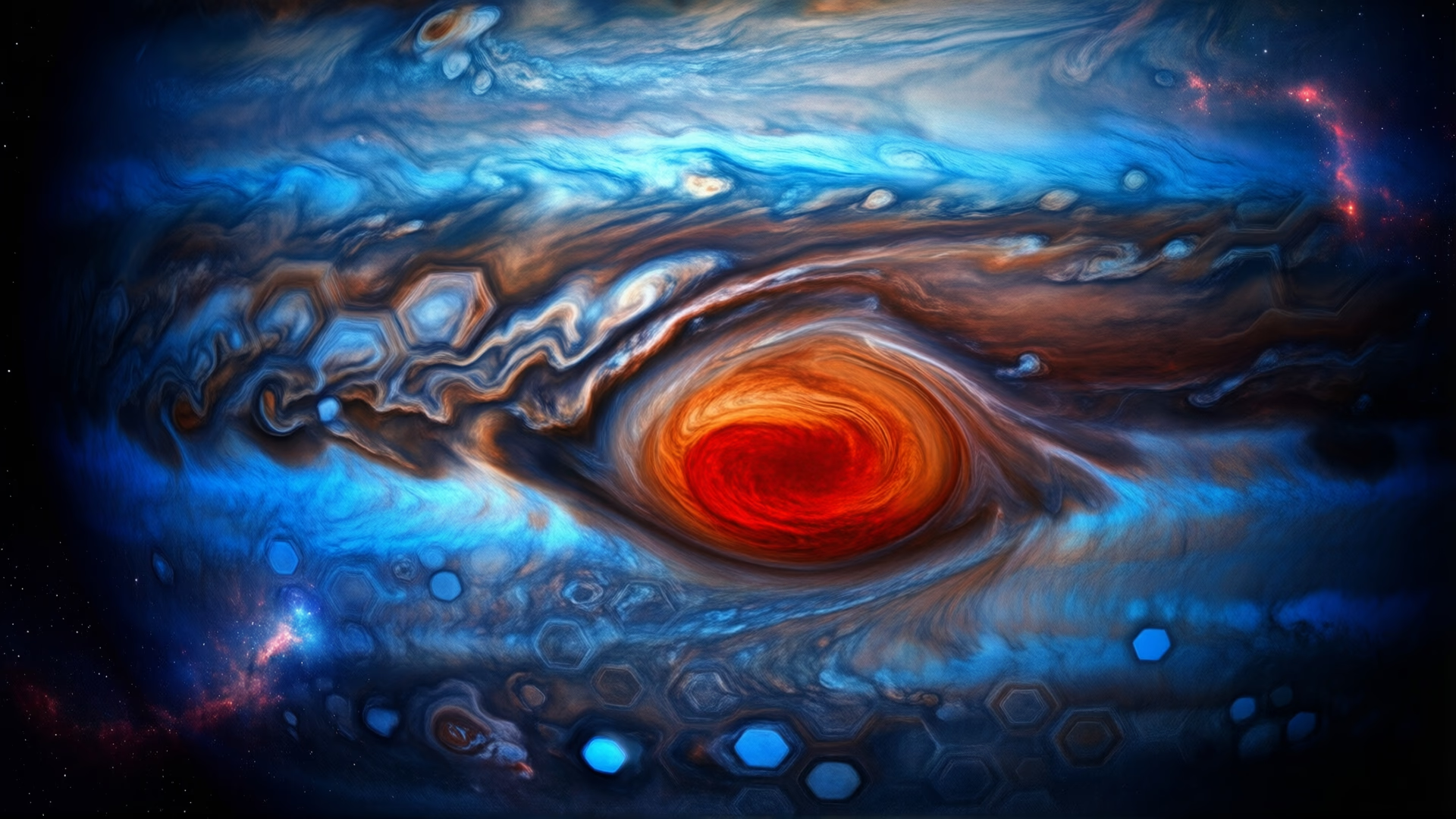
Gas giants are primarily composed of hydrogen and helium, with varying amounts of heavier elements and compounds. Their atmospheres exhibit dynamic weather patterns, including powerful storms and strong winds. The group's research includes the characterization of atmospheric circulation, radiation transport, and chemical processes on these planets. For example, Jupiter and Saturn have prominent features such as the Great Red Spot and the hexagonal cloud patterns on Saturn's north pole.
Composition and Structure Inside the Atmosphere
The outer atmosphere of a gas giant resembles a layered cloud deck, with ammonia, methane, and water ice forming visible bands and storms. Beneath the clouds, temperatures and pressures rise dramatically, compressing gases into supercritical states. Jupiter’s interior transitions from molecular hydrogen in the outer layers to metallic hydrogen deep within, generating powerful magnetic fields.
Atmospheric Composition
The atmosphere of a gas giant typically consists of hydrogen and helium, similar to Jupiter in our solar system. However, exoplanetary studies have revealed more complex compositions, including water vapor, methane, carbon dioxide, and even silicate particles in some cases.
Detection Techniques
Detecting the atmospheres of gas giants involves advanced astronomical methods:
- Transit Spectroscopy: Measures how starlight filters through a planet's atmosphere during its transit in front of the host star.
- Emission Spectroscopy: Captures the thermal radiation emitted by the planet as it moves behind its star, providing insights into atmospheric temperature and composition.
- Direct Imaging: Utilizes high-resolution imaging to block out the host star's light, allowing direct observation of the planet and its atmosphere.
Where Gas Giants Form and Their Role in Solar Systems
Gas giants form beyond the ‘snow line’ in protoplanetary disks, where temperatures are low enough for volatile compounds like water and ammonia to condense into ice. This abundance of solid material accelerates core formation, enabling rapid gas accretion before the solar nebula dissipates. Their presence influences planetary migration, potentially scattering smaller bodies and stabilizing inner system architectures.
Implications
Research on gas giants contributes to broader scientific fields such as climate change studies and planetary habitability. By examining the atmospheres of planets like Venus and Mars, scientists gain insights into Earth's climate dynamics. Additionally, comparative planetology enhances our ability to identify potentially habitable exoplanets by drawing parallels with gas giant atmospheres.
Gas Giants vs. Ice Giants: Key Differences
Gas giants lack significant amounts of ices in their dominant composition, while ice giants like Uranus and Neptune have higher proportions of frozen volatiles and weaker gravity, resulting in lower densities and distinct magnetic field alignments. Gas giants exhibit stronger magnetic fields and more massive atmospheres.
Hot Jupiters
Among the most studied gas giants are 'hot Jupiters,' which orbit close to their stars. These planets exhibit extreme conditions:
- WASP-12b: Known for significant atmospheric stripping due to intense stellar radiation.
- HD 189733b: Features silicate clouds, suggesting high-altitude weather phenomena.
Water Worlds
Some gas giants, like K2-18b, show signs of water vapor in their atmospheres, raising questions about their formation and potential habitability.
Insights from Recent Research
Recent observations from missions like JWST and improved ground-based telescopes refine models of gas giant atmospheres, including cloud dynamics and chemical abundances. Future probes, such as ESA’s JUICE mission, promise deeper insights into gas giant environments and their role in the broader cosmic ecosystem.
Future Research
Advanced space telescopes are set to revolutionize exoplanet atmospheric studies:
- James Webb Space Telescope (JWST): Capable of detecting complex molecules and biosignatures.
- Ariel Mission: Aims to study 1,000 exoplanets, focusing on atmosphere composition and planetary evolution.
- LUVOIR and HabEx Concepts: Proposed missions to directly image Earth-like planets and assess habitability.
Formation of Gas Giants
The formation of gas giants involves the accretion of both solids and gas in the protoplanetary disk. This process, supported by models such as those proposed by Pollack et al. (1996), suggests that gas giants begin as cores of rock and ice that accumulate significant amounts of gas from the surrounding nebula. The growth of these cores is influenced by their proximity to the central star and the dynamics of the protoplanetary disk.
Planetary Migration and Gas Giants
Planetary migration plays a crucial role in shaping the architecture of planetary systems, including those involving gas giants. Mechanisms such as Type I and Type II migration, driven by gravitational interactions with the protoplanetary disk, can cause gas giants to move inward or outward from their initial formation sites. This process is responsible for phenomena like the creation of 'hot Jupiters,' where gas giants end up in close orbits around their stars due to inward migration.
Hot Jupiters and Resonant Systems
Hot Jupiters are a specific type of gas giant that orbit very close to their host stars, often much closer than Mercury orbits the Sun. Their formation is linked to planetary migration mechanisms, where gravitational interactions with the disk or other planets result in orbital changes. These processes also contribute to the formation of resonant systems, where multiple planets influence each other's orbits through gravitational interactions.
Impact of Stellar Radiation and Winds
Stellar radiation and winds significantly impact the development and evolution of gas giants. These forces can strip planetary atmospheres, influence atmospheric chemistry, and affect habitability. Observational studies have shown that stellar-planetary interactions shape the magnetic fields and overall evolution of gas giants, particularly in their outer layers.
Observational Evidence
Observations of exoplanet atmospheres and orbital dynamics provide strong evidence for the effects of stellar radiation and winds on gas giants. These findings support theoretical models of planetary formation and migration, highlighting the complex interplay between gravitational forces, disk-planet interactions, and stellar evolution in shaping diverse planetary systems.
Factors Influencing Differentiation
- Planetary Size: Larger gas giants experience more extensive differentiation due to greater gravitational energy. - Composition: Presence of hydrogen, helium, and ice influences density contrasts. - Temperature: Higher temperatures can enhance differentiation by reducing interior viscosity.
Consequences of Planetary Differentiation in Gas Giants
- Results in distinct planetary layers that shape the planet's structure and composition. - Influences surface features and geological processes, such as atmospheric circulation and magnetic field generation. - The presence of a dense core may indicate potential for a magnetic field, which can protect the planet from harmful radiation.
Implications for Planetary Habitability
- Gas giants' unique compositions and structures contribute to their distinct environments, affecting their potential for supporting life or hosting habitable moons.
Composition of Gas Giants
Gas giants typically have three main layers: 1. Core: A dense, rocky or metallic core at the center. 2. Mantle: A layer of hydrogen and helium above the core. 3. Outer Layers: May include ice and other volatile materials, depending on the planet's distance from the Sun.
Mechanisms of Planetary Differentiation in Gas Giants
- The process is driven by gravity and density contrasts during planetary accretion. - Heavier elements like iron and nickel sink to form a core, while lighter gases rise to form the outer layers.
[1]: What Is a Gas Giant? Key Facts Explained [2]: Planetary Atmospheres - mps.mpg.de [3]: Comparative Planetology → Term [4]: The Science of Exoplanet Atmospheres: Detecting Alien Skies [5]: Theories of Planetary Formation: A Comprehensive Guide [6]: Planetary Differentiation Explained - numberanalytics.com