Overview
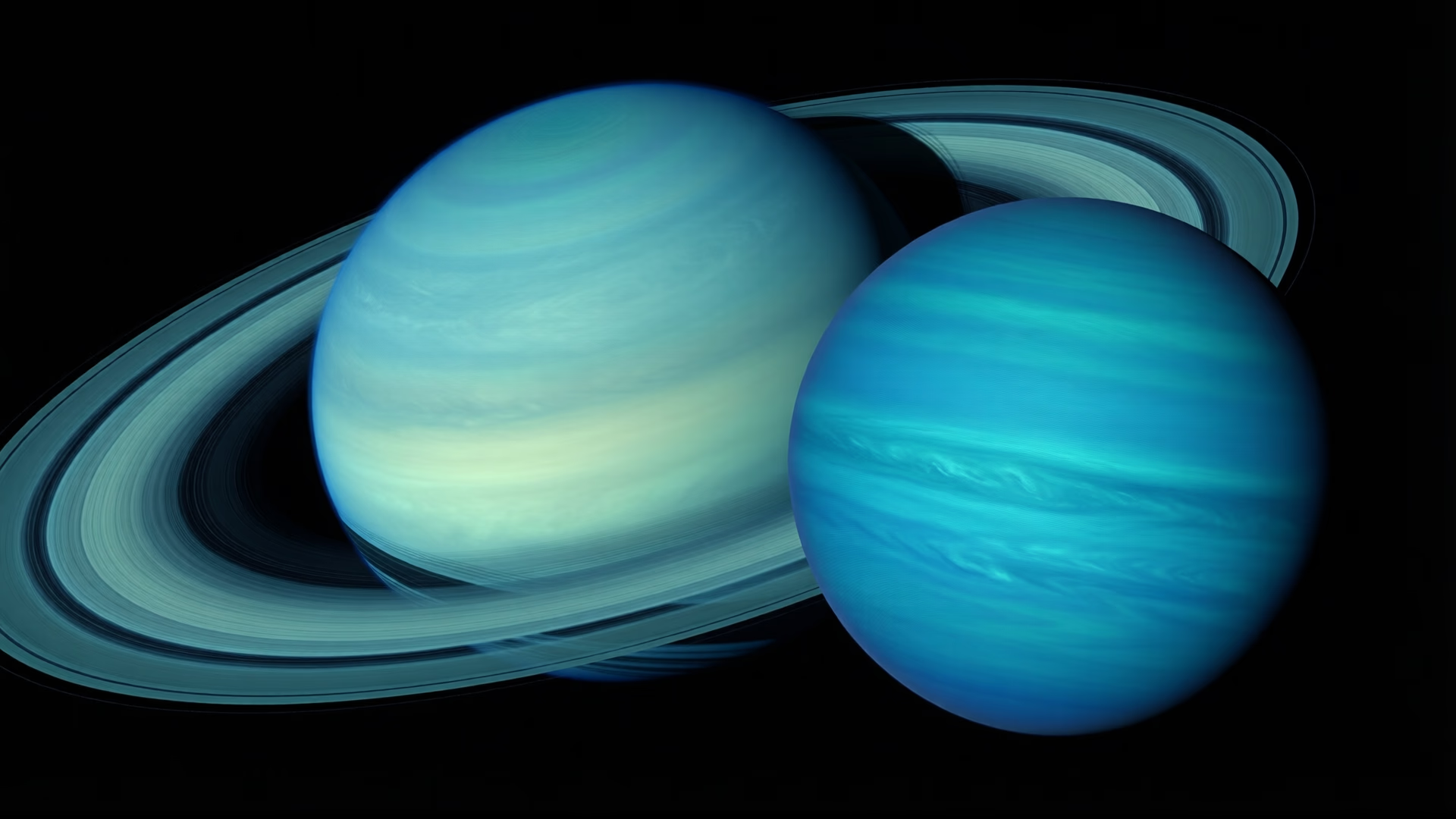
The Ice Giants are the two outer planets of the Solar System: Uranus and Neptune. These gas giants are primarily composed of volatile compounds such as water, ammonia, and methane, which give them their distinctive blue-green coloration. Unlike the more massive gas giants Jupiter and Saturn, Uranus and Neptune are often referred to as "ice giants" due to their composition.
Formation Theories
The formation of Ice Giants is a subject of extensive research in planetary science. One widely discussed theory suggests that these planets formed through planetary migration, where they moved inward from their initial positions in the outer solar system. This movement allowed them to capture hydrogen and helium gas, distinguishing them from other types of planets.
Formation
Ice Giants formed in the outer regions of the protoplanetary disc more than 4.5 billion years ago. Their formation involved accreting materials under cooler conditions farther from the Sun, leading to a higher proportion of ice in their compositions compared to the gas giants. This process resulted in distinct internal structures and magnetic characteristics.
Key Concepts
Evolution
Understanding the evolution of Ice Giants involves studying physical processes that affect their structure and composition over time. Research methods include numerical simulations and semi-analytical calculations to model these processes.
Composition
Uranus and Neptune are composed of a mixture of volatiles (water, ammonia, methane) and ice. The term "ice" refers to the compressed and heated state of these compounds within the planets, rather than solid ice. This composition sets them apart from the gas giants, which are dominated by hydrogen and helium.
Composition and Structure
Uranus and Neptune are primarily composed of hydrogen and helium, with a higher proportion of ices such as water, methane, and ammonia compared to the gas giants. This composition results in their blue coloration due to the absorption of red light by methane in their atmospheres. Unlike Jupiter and Saturn, which have larger silicate cores surrounded by layers of metallic hydrogen, Ice Giants possess smaller silicate cores that are encased within a mantle of ice and gas.
Coloration
Both Uranus and Neptune appear blue-green due to methane absorption in their atmospheres. However, Neptune's color appears deeper blue compared to Uranus, likely due to differences in high-altitude hazes and methane distribution.
Winds and Climate
Neptune is known for its extremely fast winds, reaching up to 2,400 km/h (1,500 mph), driven by an internal heat source. In contrast, Uranus has relatively slower wind speeds. These differences highlight the unique atmospheric dynamics of each planet.
Magnetic Fields
Both planets have unusual magnetic fields that are tilted and offset from their rotational axes, unlike the more regular fields of other gas giants like Jupiter or Saturn. This characteristic adds to their enigmatic nature.
Magnetic Fields
The magnetic fields of Uranus and Neptune differ significantly from those of the gas giants. They are weaker and more irregular in shape, possibly due to their unique internal structures and differing formation processes. This contrasts with the strong, regular magnetic fields of Jupiter and Saturn, which are generated by their metallic hydrogen layers.
Rings and Moons
Uranus has a faint system of rings discovered by Voyager 2 in 1986, while Neptune's rings include "ring arcs," also revealed during the same mission. Uranus has 27 known moons, whereas Neptune has 14, including Triton.
Triton
Triton, Neptune's largest moon, is notable for its active geysers of nitrogen gas and potential subsurface ocean, making it a prime candidate for astrobiological study.
Observations and Visibility
Uranus can be seen with the naked eye under ideal conditions (magnitude ~5.7), but binoculars or a small telescope enhance viewing. Neptune is dimmer (magnitude ~7.8) and requires at least a 200-300mm telescope to observe its disk and larger moons like Triton.
Exploration
Future missions are planned to explore Uranus and Neptune, focusing on their atmospheres, magnetospheres, rings, and moons. These missions aim to address questions about planetary formation and migration.
Future Exploration
Despite significant advancements in planetary science, much remains unknown about Ice Giants due to the challenges in studying them. Future space missions aim to gather more data on their internal structures and compositions, potentially providing deeper insights into their formation and evolution.
Current Research
Research groups focus on various aspects of planetary formation, including the study of giant and intermediate-mass planets. Space missions like Juno and JUICE provide valuable data for understanding these planets, while exoplanet missions like PLATO and ARIEL expand our knowledge through comparative studies beyond our Solar System.
Exoplanet Relevance
Studying Uranus and Neptune provides insights into exoplanets, particularly "sub-Neptune" class planets. This research helps model atmospheric conditions and understand chemistry shaped by stellar irradiation.
[1]: Uranus and Neptune: Ice Giants Explained & Observing [2]: Planet Formation | Department of Astrophysics | UZH [3]: What is inside of the planets of the Solar System