Overview
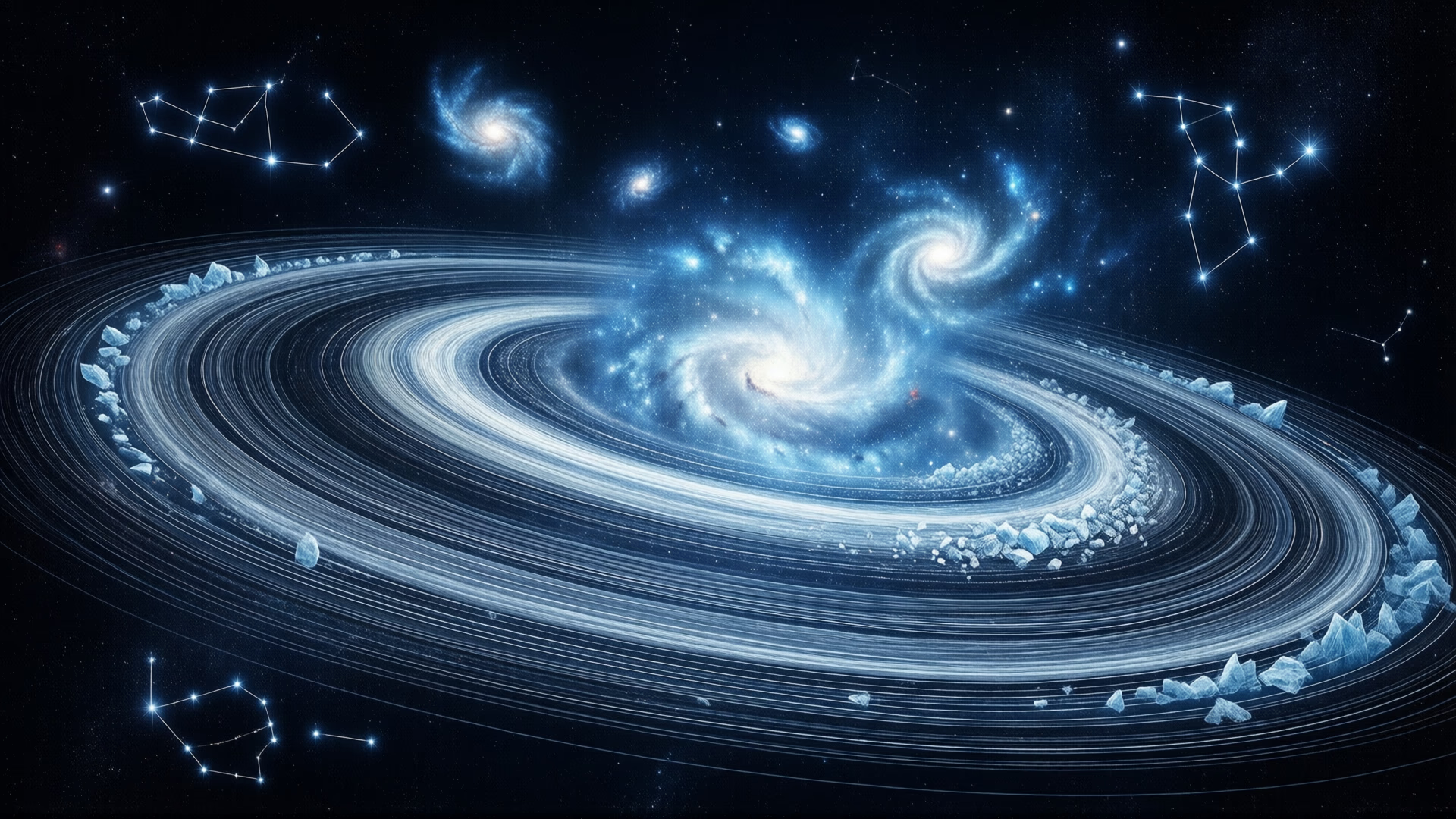
Planetary formation is the process by which planets are created through the accretion of smaller particles called planetesimals. This process leads to the development of a layered structure within the planet due to processes like differentiation.
Overview
Planetary formation is the process by which planets are created through the accretion of smaller particles called planetesimals. This process leads to the development of a layered structure within the planet due to processes like differentiation.
Key Concepts
- Volatile Elements: Substances like hydrogen, carbon, nitrogen, and oxygen that play a crucial role in planetary formation. - Isotopic Ratios: The study of ratios such as carbon/nitrogen and hydrogen isotopes provides insights into the origin and transport of volatiles during planetary accretion and evolution. - Core-Mantle Partitioning: The distribution of elements between a planet's core and mantle, significantly influenced by chemical speciation during differentiation.
Formation Process
Process of Planetary Formation
Planetary formation begins with the aggregation of dust and gas in the protoplanetary disk surrounding a young star. Over time, these particles collide and stick together, forming larger bodies known as protoplanets. As these protoplanets grow, they generate heat through accretion, causing materials to become molten. This melting facilitates planetary differentiation, where denser materials like iron and nickel sink towards the center, forming the core, while lighter materials such as silicates rise to form the mantle and crust.
Accretion and Differentiation
The planetary formation process begins with the accretion of materials in a protoplanetary disk. During this phase, smaller bodies collide and merge, leading to the growth of larger planets. The era of giant impacts, which lasted until about 4.4 billion years ago, marked the final stages of this accretion phase. Following accretion, planetary differentiation occurred as heavier materials sank to the core, while lighter materials formed mantles and crusts. This process was influenced by internal heat from radioactive decay and residual heat from the accretion process.
Gas Giants
Gas giants form in colder regions where water can freeze. Ice fragments combine with dust to create large cores, which attract gas due to slower molecular movement. This rapid growth explains how Jupiter and Saturn formed quickly after the solar system's birth.
Rocky Planets
Rocky planets develop in warmer areas closer to the star. The absence of gas left by gas giants allows these planets to form over tens of millions of years, resulting in terrestrial worlds like Earth and Mars.
Layers of a Planet
A differentiated planet typically consists of three main layers:
- Core: The innermost layer, composed primarily of dense metallic elements like iron and nickel.
- Mantle: Lies above the core and is made up of silicate minerals that are less dense than the materials in the core.
- Crust: The outermost layer, a thin layer of solid rock where most geological processes occur.
Planetary Systems
A planetary system consists of one or more planets along with dwarf planets, asteroids, comets, and moons orbiting a central star. Examples include the Solar System and extrasolar systems hosting exoplanets.
Tidal Influences
Tidal forces not only affect the internal heat of moons but also play a role in their orbital dynamics and long-term evolution. These forces are particularly significant in the outer solar system, where icy moons exhibit unique geological features due to low-temperature volcanism and other tidal-driven activities.
Internal Heat and Tidal Forces
Internal heat generated during accretion and maintained through radioactive decay played a crucial role in shaping planetary interiors. Larger planets retained this heat longer, leading to prolonged geological activity. Additionally, tidal forces exerted by massive parent bodies, such as Jupiter on Io or Saturn on Enceladus, caused gravitational flexing and contributed to the internal heating of moons, influencing their geological evolution.
Ongoing Research
The specific locations within disks where planets form remains an area of active research, highlighting our ongoing quest to understand this cosmic process fully.
Significance of Planetary Formation
Understanding planetary formation helps scientists unravel the history and evolution of planets. It provides insights into early planetary conditions and their development over time, contributing to our knowledge of solar system dynamics and the potential for habitability on other planets.
Factors Influencing Atmospheric Evolution
Three primary factors shape the evolution of planetary atmospheres: geological activity, biological processes, and atmospheric escape.
Comparative Studies
Comparative studies reveal diverse atmospheric evolution paths among planets like Earth, Mars, and Venus.
Insights from Icy Moons
Studying icy moons enhances understanding of potential habitability beyond Earth, contributing to the search for life in the solar system and exoplanets.
Implications for Exoplanet Studies
Understanding atmospheric evolution aids in identifying biosignatures in exoplanet atmospheres, employing comparative studies and simulations.
History
The concept of planetary formation has evolved significantly with advancements in astrophysics and planetary science. Early theories focused on the accretion of gas and dust from a protoplanetary disk, while later studies incorporated the role of outgassing and solar radiation in shaping atmospheres.
Accretion and Outgassing
Accretion refers to the accumulation of gas and dust from a protoplanetary disk, forming the early stages of planetary cores. Outgassing complements this process by releasing gases trapped within the planet's interior, such as carbon dioxide and sulfur dioxide, through volcanic activity.
Solar Radiation Effects
Solar radiation plays a pivotal role in atmospheric evolution through photodissociation and photoionization. Ultraviolet radiation can break down molecules like water and methane, significantly altering the composition of a planet's atmosphere.
Magma Oceans
Magma oceans are molten regions that covered early planetary bodies. Fractionation processes in these oceans played a critical role in determining the distribution of volatiles like nitrogen and carbon, leading to the observed superchondritic C/N ratio in Earth's silicate mantle.
Meteorites and Asteroids
- Angrites: These meteorites provide stable isotope data on carbon and nitrogen, contributing to understanding volatile inventories in small planetary bodies. - Chondrites: Their macromolecular organic matter likely originates from interstellar or cometary sources, influencing life-forming elements.
Hydrogen Isotopes and Water Reservoirs
Hydrogen isotopes in basalts help unravel the history of water in Earth's mantle. Research highlights the role of small planetary bodies (meteorites, asteroids, comets) in delivering volatiles to terrestrial planets, emphasizing the importance of isotopic studies.
Early Solar System Volatiles
The origin and distribution of life-forming volatile elements in the inner solar system are central to understanding planetary evolution. These processes have implications for the emergence of life on Earth, as they shaped the chemical environment necessary for its development.
Key Concepts
- Volatile Elements: Substances like hydrogen, carbon, nitrogen, and oxygen that play a crucial role in planetary formation. - Isotopic Ratios: The study of ratios such as carbon/nitrogen and hydrogen isotopes provides insights into the origin and transport of volatiles during planetary accretion and evolution. - Core-Mantle Partitioning: The distribution of elements between a planet's core and mantle, significantly influenced by chemical speciation during differentiation.
Volatile Elements and Isotopic Ratios
- Carbon: Its isotopic composition in meteorites and Earth provides clues about the sources of volatiles. - Nitrogen: Nitrogen isotope studies on iron meteorites offer insights into volatile origins during planetary formation. - Hydrogen: Hydrogen isotopes in basalts reveal information about water's history in the mantle.
Core-Mantle Partitioning
The concentration and speciation of carbon in magma oceans significantly impact its partitioning between a planet's core and mantle. This process shapes the volatile inventory of rocky bodies, influencing their chemical evolution.
Impact Processes and Planetary Evolution
Impact processes are integral to understanding planetary evolution. These events can lead to:
- Crater Formation: The creation of impact craters on planetary surfaces, which provide geological records of past collisions.
- Ejecta Distribution: The dispersal of material across planetary systems, influencing the composition of other bodies.
- Chemical and Physical Changes: Alterations in a planet's surface chemistry, atmosphere, and interior due to high-energy impacts.
Research into impact processes has revealed their importance in:
- Shaping the Earth-Moon system (e.g., the formation of the Moon).
- Influencing the environmental conditions necessary for life on Earth.
- Governing the dynamics of planetary accretion and satellite formation.
Current Research Directions
Recent studies focus on:
- Satellite Formation: Investigating how satellites, such as those orbiting Mars, form through disruptive partial capture of asteroids or other bodies.
- Cratering Mechanics: Developing advanced methods to reconstruct impact events using single-imagery and numerical simulations.
- Biomolecule Synthesis: Exploring the potential for impact vapor plumes to synthesize complex organic molecules, which could contribute to the origins of life.
These research areas highlight the ongoing importance of understanding planetary formation through the lens of impact processes, offering insights into both our solar system and extrasolar systems.
[1]: How Do Planets Form? - Science@NASA [2]: Planetary Differentiation - Definition & Detailed Explanation ... [3]: 14.5 Planetary Evolution - Astronomy [4]: Atmospheric Evolution in Planetary Science [5]: Using carbon isotopes to trace the origin of volatiles on Earth and ... [6]: Impact processes and planetary evolution - ScienceDirect
References
- How Do Planets Form? - Science@NASA ↩
- Planetary Differentiation - Definition & Detailed Explanation ... ↩
- 14.5 Planetary Evolution - Astronomy ↩
- Atmospheric Evolution in Planetary Science ↩
- Using carbon isotopes to trace the origin of volatiles on Earth and ... ↩
- Impact processes and planetary evolution - ScienceDirect ↩