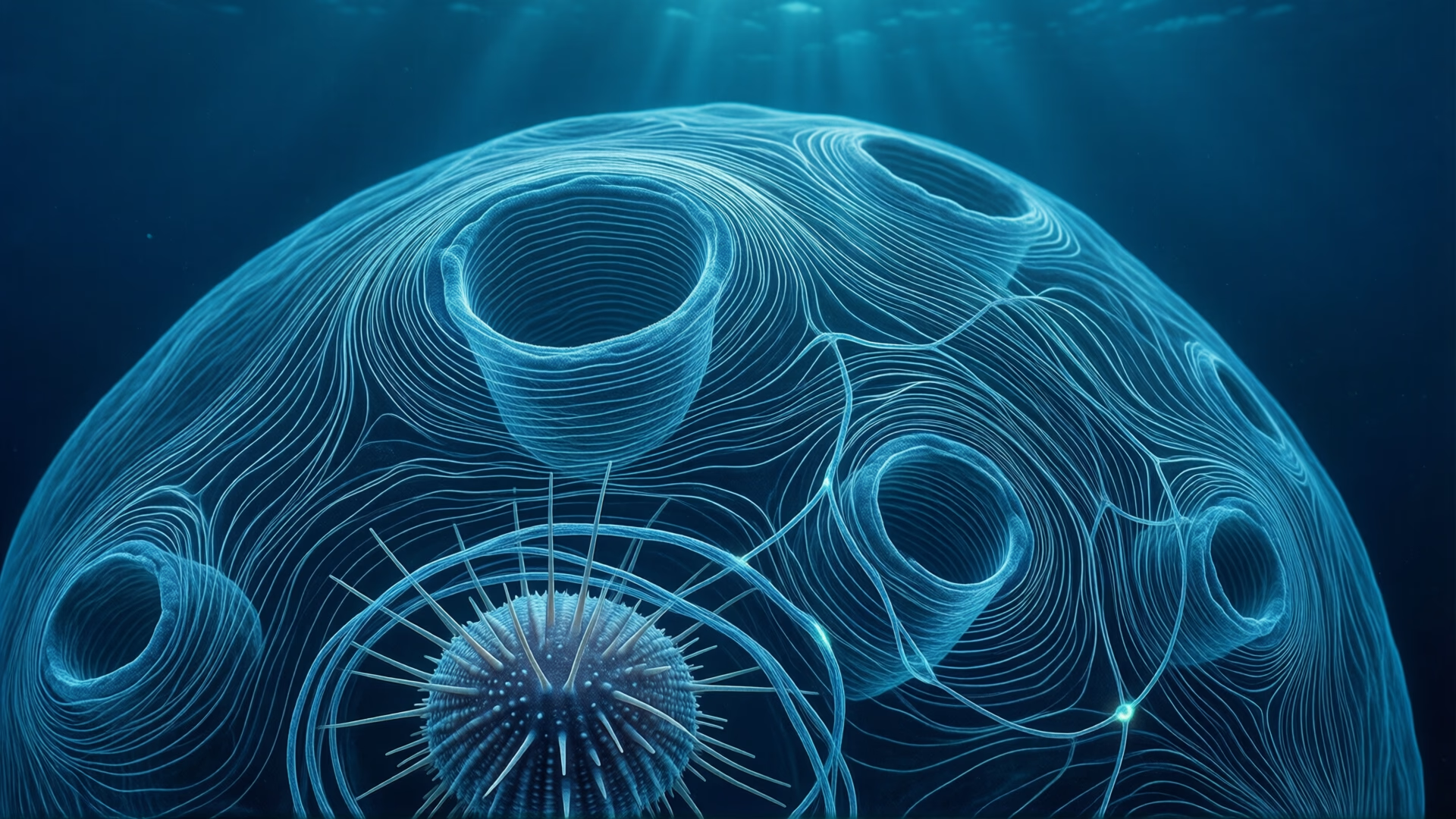
Overview
The cytoskeleton is a complex network of protein filaments found in the cytoplasm of all cells. It plays a critical role in maintaining cell structure, facilitating movement, and organizing cellular components. The term "cytoskeleton" was first introduced by Nikolai K. Koltsov in 1903.
Historical Context
Classical experiments by Rappaport on toroidal sand dollar zygotes demonstrated that furrows can initiate across spindles and between them. These findings highlighted the independence of furrow initiation from chromosome alignment but emphasized the role of specific factors in completion.
History
The concept of the cytoskeleton was proposed by Nikolai K. Koltsov in 1903. Over time, advancements in microscopy and molecular biology have deepened our understanding of its structure and functions.
Key Concepts
Structure of the Cytoskeleton
The cytoskeleton is composed of three primary structural elements: microtubules, intermediate filaments, and microfilaments.
Microtubules
- Diameter: Approximately 24 nm.
- Composition: Made of tubulin dimers (alpha-tubulin and beta-tubulin).
- Structure: Consists of 10 to 15 protofilaments, typically 13 in mammalian cells.
- Characteristics: Highly dynamic, capable of rapid polymerization and depolymerization.
Functions:
- Facilitates cell movement.
- Supports intracellular transport via motor proteins (kinesins and dyneins).
- Plays a role in cell division.
Intermediate Filaments
- Diameter: Approximately 10 nm.
- Function: Provides tensile strength to the cell.
Types:
- Type I and II: Keratins involved in cell-cell junctions or matrix attachment.
- Type III: Vimentin (found in WBCs, fibroblasts) and Desmin (skeletal, cardiac, and smooth muscles).
- Type IV: Neurofilaments in neuronal cells.
- Type V: Lamins in the nuclear membrane for mechanical stability.
Microfilaments
- Diameter: 3-5 nm.
- Composition: Composed of actin subunits (G-actin and F-actin).
Functions:
- Enables cellular movements like gliding, contraction, and cytokinesis.
Motor Proteins
Motor proteins facilitate intracellular transport along the cytoskeleton. Two main types exist:
- Kinesins: Function at the positive (+) end of microtubules.
- Dyneins: Function at the negative (-) end of microtubules.
Functions:
- Transport organelles and vesicles in opposite directions.
- Participate in processes like exocytosis, endocytosis, and cytokinesis.
Cytoskeletal Networks
- Actin Filaments: Critical for protrusion formation, adhesion, and contractility during cell migration. - Microtubules: Involved in maintaining cell polarity, focal adhesion dynamics, and intracellular transport. - Intermediate Filaments: Play a role in stabilizing the cytoplasm and regulating signaling hubs during migration.
Cytoskeletal Crosstalk
- Actin, microtubules, and intermediate filaments are interconnected through direct interactions, shared signaling pathways, and regulatory proteins. This crosstalk is essential for processes like focal adhesion turnover and cell contractility.
Rho GTPases
- RhoD: Regulates actin dynamics and directed migration. - Rac/Cdc42: Phosphorylate stathmin, affecting microtubule stability, and are activated by signaling molecules like STEF (Tiam2).
Cdc42 and Cell Polarization
- Cdc42, in conjunction with Par6–PKCζ, controls cell polarization by regulating the spatial arrangement of adhesion complexes. WASP restricts Rac activity to maintain front-rear polarity.
Mechanochemical Coupling
- A signaling network connects microtubules, myosin IIA filaments, and integrin adhesions to regulate migration forces and dynamics.
Focal Adhesions
- Microtubules: Play a dual role in stabilizing or destabilizing focal adhesions depending on the cellular context. - Signaling: Rac activation by STEF mediates microtubule-dependent focal adhesion disassembly, influencing cell migration.
Intermediate Filaments in Migration
- Vimentin interacts with alpha6beta4 integrins to form signaling hubs that regulate epithelial cell migration. Microtubule-associated motors drive the polarization of intermediate filament networks.
circRNAs and Cytoskeleton Remodeling
- Emerging research highlights the role of circular RNAs, such as circRNA-YBX1, in phase separation processes that remodel the cytoskeleton and impact cancer metastasis.
Contractile Rings and Cytokinesis
In sea urchin embryos, contractile rings form around tiny buds during asymmetric cleavage, facilitating cell division. The positioning of the mitotic spindle is critical for determining the outcome of cytokinesis, especially in cells undergoing unequal division.
Spindle Orientation and Furrow Formation
The orientation of the mitotic spindle plays a crucial role in cytokinesis. Studies on C. elegans embryos reveal that furrows form where asters overlap and near the central spindle. The presence of factors like centralspindlin is essential for furrow completion, as seen in experiments with anucleate cells.
Axonal Transport
Proper axonal transport is vital for delivering materials to the ends of neurons, maintaining their survival, and ensuring normal function. Defects in this process can lead to diseases like CMT and ALS.
Functions of the Cytoskeleton
The cytoskeleton performs several essential roles:
- Provides motility and mechanical support: Enables cell movement and shape maintenance.
- Organizes cellular components: Ensures proper placement of organelles and structures.
- Facilitates intracellular transport: Assists in the movement of vesicles, proteins, and other molecules.
Structural Integrity
The cytoskeleton contributes to the structural integrity of neurons, supporting their survival, growth, and function. Dysregulation of these structures is associated with aging and neurodegenerative processes.
Neurofilaments
Neurofilaments are a type of intermediate filament specific to neurons. Mutations in neurofilament proteins can lead to diseases such as Charcot-Marie-Tooth (CMT) disease and amyotrophic lateral sclerosis (ALS).
Neurofilament Depletion
Depleting neurofilaments can improve microtubule dynamics by modulating signaling pathways like Stat3/stathmin, highlighting the interplay between cytoskeletal components in maintaining neuronal health.
Spastin and Katanin
These proteins are involved in severing microtubules, playing roles in axonal branching and the formation of neuronal networks. Mutations can lead to hereditary spastic paraplegia.
Radixin and Moesin
Radixin and moesin regulate growth cone morphology and neuronal process formation. Their suppression can alter axonal growth and branching, affecting development.
Post-translational Modifications
Post-translational modifications, such as phosphorylation and acetylation, regulate microtubule dynamics and functions. These modifications are essential for proper neuronal development and function.
Tubulin Code
The 'tubulin code' refers to post-translational modifications that encode specific information for microtubule function and regulation. Understanding this concept is critical for unraveling normal neuronal functions and diseases such as peripheral neuropathy.
Cell Migration Complexity
- Modern studies emphasize the integration of transmembrane receptors, adhesive complexes, cytoskeletal components, nuclear mechanisms, and extracellular matrix interactions in cell migration. Intracellular signaling and biomechanical forces are increasingly recognized as key drivers of migratory processes.
Model Organisms
Sea Urchins
Sea urchin embryos exhibit highly unequal cleavage, resulting in cells of varying sizes (e.g., mesomeres, macromeres, micromeres). The fourth cleavage is notable for its asymmetry, with the mitotic spindle positioned eccentrically. This mechanism involves interactions between astral microtubules and the cortex.
C. elegans
In C. elegans, furrows form where asters overlap and near the central spindle. The central spindle 'ratifies' furrow progression by hoarding centralspindlin, which is necessary for furrow completion.
Significance
The cytoskeleton is fundamental to nearly all aspects of cell biology, including growth, division, and interaction with the environment. Defects in its structure or function can lead to severe cellular abnormalities and diseases.
Future Directions
Further research into cytoskeletal dynamics is expected to uncover novel regulatory mechanisms and molecular interactions that will deepen our understanding of cell migration and its implications in health and disease.
[1]: Cytoskeleton - Definition, Structure, Components, Functions [2]: Editorial: Cytoskeletal alterations in aging and disease - PMC [3]: Cytoskeletal Dynamics During Cytokinesis [4]: Cytoskeletal Crosstalk in Cell Migration - ScienceDirect