Overview
Prokaryotic cells are unicellular organisms that lack a true nucleus and membrane-bound organelles. They form the basis of life within the domains Bacteria and Archaea, while all other forms of life are eukaryotic. These cells are characterized by their simplicity in structure and function, yet they play critical roles in ecosystems and human health.
History
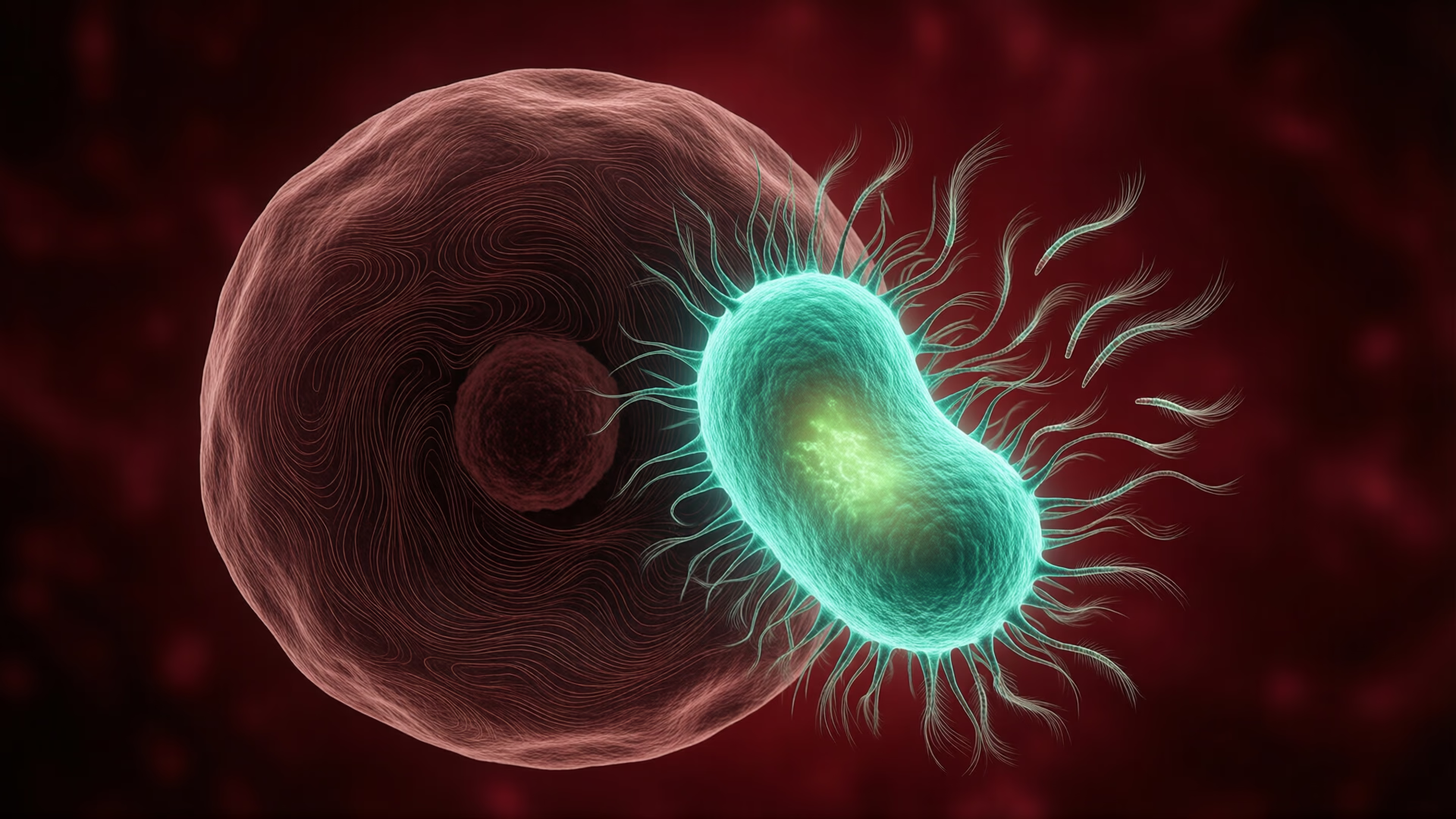
The Endosymbiotic Theory suggests that early prokaryotic cells were engulfed by larger cells, leading to the development of organelles like mitochondria and chloroplasts in eukaryotic cells. This theory highlights the evolutionary relationship between prokaryotes and eukaryotes.
Prokaryotic Cell
Prokaryotic Cell Structure
Prokaryotic cells have a nucleoid region where DNA is located, but it lacks a nuclear envelope. All prokaryotic cells possess a cell membrane made of phospholipid molecules that separate the internal environment from the external one. Many prokaryotes have additional structures such as cell walls for protection and support. The composition of these walls varies; for example, bacteria have peptidoglycan walls. Prokaryotic DNA is typically circular and houses genetic instructions for protein synthesis and cellular regulation.
Prokaryotic cells contain ribosomes, which are essential for protein production, and their cytosol includes a cytoskeleton that organizes cellular components. Some prokaryotes have appendages like flagella for movement, pili for adhesion, and a capsule for adherence to surfaces.
Characteristics of Prokaryotic Cells
Prokaryotic cells are smaller than eukaryotic cells, ranging in size from 0.1 to 5 micrometers compared to 10 to 100 micrometers for eukaryotes. Their small size contributes to a higher surface-area-to-volume ratio, which facilitates efficient nutrient acquisition through the plasma membrane.
Significance
The study of prokaryotic cells is fundamental to understanding the origins of cellular complexity and life itself. Their role in the Endosymbiotic Theory underscores their importance in evolutionary biology.
Examples of Prokaryotic Cells
Bacteria and archaea are examples of prokaryotic cells. Bacteria are widespread and include species that reside in the human gut, aiding digestion by breaking down complex molecules like carbohydrates, proteins, and fats. Some bacteria can form endospores, which allow them to survive extreme conditions. Archaea resemble bacteria in size and shape but have distinct cell wall and membrane structures.
How Prokaryotic Cells Divide
Prokaryotic cells reproduce through binary fission, a simpler process than eukaryotic cell division due to the absence of complex organelles and linear DNA. When a prokaryote reaches sufficient size, it duplicates its DNA and divides into two daughter cells, enabling rapid reproduction.
Importance of Prokaryotic Cells
Prokaryotes are vital for various ecological and biological functions. In humans, gut bacteria outnumber human cells 10:1 and play a crucial role in digestion. Despite their simplicity compared to eukaryotes, prokaryotic cells have adapted to thrive in diverse environments, from extreme conditions like hot springs to the human body. Their ability to reproduce quickly and efficiently contributes to their abundance on Earth.
This article provides a concise overview of prokaryotic cells, highlighting their structure, characteristics, examples, and ecological significance based on the provided source text.
Comparison with Eukaryotic Cells
Prokaryotic cells differ from eukaryotic cells in several ways: they lack membrane-bound organelles, have a simpler structure, reproduce through binary fission instead of mitosis or meiosis, and are generally unicellular. This simplicity allows them to adapt quickly to various environments.
[1]: Prokaryotic Cell - Definition, Examples & Structure - Biology Dictionary [2]: Eukaryotic Cell - Diagram, Definition, Facts